
Crawford Federal Detention Release Paths
The federal system serving Crawford County is a network, not one local prison. USMS manages federal pretrial custody and can place defendants in state or local contract jails. The Crawford County Sheriff reports such a partnership at its Detention Center. After conviction and commitment, the Federal Bureau of Prisons administers federal prison custody. ICE detention is a separate immigration channel that should be used only when the individual record supports that connection.
A person can leave the Crawford County Detention Center and remain in federal custody. USMS may transport the defendant to court, move the person to a different contract jail, or carry out another federal order. A later BOP admission may follow a sentence, but not every federal pretrial move creates a BOP locator record. That is why the local timestamp must be read as departure from one facility rather than a broad statement that all custody ended.
| Custody stage | Primary sources | What a departure may mean |
|---|---|---|
| Crawford contract-jail stay | Sheriff released/transfer record, federal docket, USMS | Community release, court transport, or transfer to another custodian. |
| Federal pretrial custody | Federal court docket, clerk, USMS inquiry | Release under a court order or continued detention elsewhere. |
| Sentenced federal custody | BOP locator and BOP records | Current placement, transit, or a BOP release result. |
| Immigration detention | ICE ODLS and ERO, supported by transfer evidence | Current ICE custody or an inconclusive no-result. |
Confirm a Crawford Federal Departure
Begin with the Sheriff’s 48-hour released list when the person was recently housed at the Crawford County Detention Center. Match the name, booking number, booking date and time, charges, and exact release timestamp. The web fields do not promise a release reason or receiving agency, so request the release or transfer log when the destination is missing.
- Confirm the person and booking on the county released view rather than relying on absence from the current roster.
- Ask whether the recorded destination was community, USMS, BOP, ICE, another jail, court, or another authority.
- Read the federal docket for the detention, release, transfer, sentencing, or commitment order.
- Contact the federal clerk or USMS when the pretrial docket does not resolve physical custody.
- Use the BOP locator for sentenced federal custody and many later release records, not as the sole tool for a contract-jail move.
- Use ICE ODLS only when an immigration transfer is documented, and treat no result as inconclusive.
The strongest conclusion should match the evidence. A Sheriff timestamp can prove that the person left the Crawford jail. A filed federal order can prove the legal authorization. A USMS response or transfer record can prove continuing pretrial custody. A BOP result can prove that the person is or is no longer in BOP custody. Those facts should not be collapsed into the broader claim that the person is free.
BOP Release Search for Crawford Cases
The official Federal Bureau of Prisons inmate locator accepts BOP, DCDC, FBI, or INS number searches. A name search can add age, race, and sex. Verified result fields include name, register number, age, race, sex, release date, and location. Number search is usually the safer route because names can collide.
BOP explains that “Released” or “Not in BOP Custody” means the person is no longer in BOP custody. It does not establish the end of federal supervised release, a state hold, an immigration detention, or another sovereign’s custody. A past release date without a facility indicates release from BOP on that date. “Unknown” means the term is undetermined. “In Transit” can involve USMS movement and can, according to BOP, end in a court release without further BOP notice.
The locator updates daily, and calculated dates can change. Its records guide generally covers releases after 1982; older federal records may require the National Archives. The successful manifest capture comes from the official BOP locator.
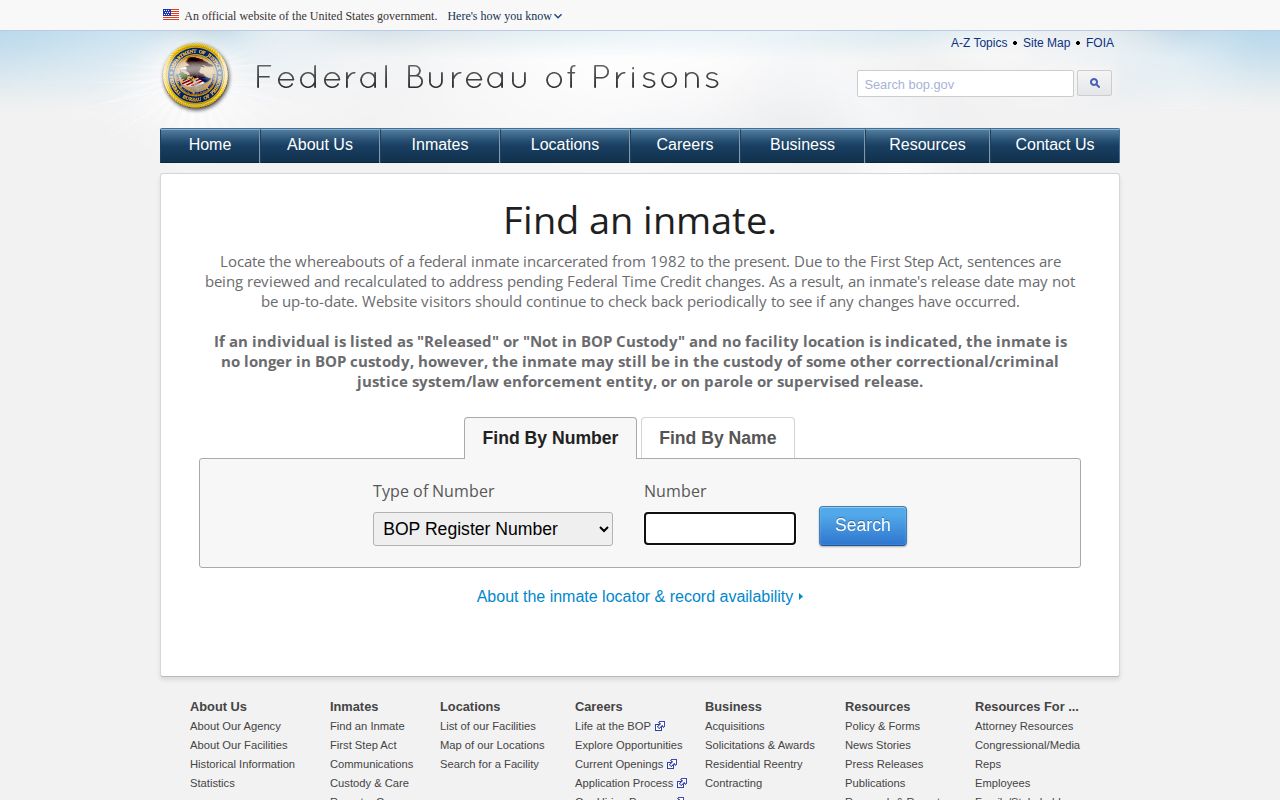
The locator is valuable for sentenced custody and many releases, while the Crawford contract-jail record and federal docket remain central to a local pretrial departure.
Crawford Federal Release Records
There is no USMS public historical release locator equivalent to BOP’s tool. For a federal pretrial defendant who left the county jail, request the county release or transfer record and inspect the federal docket. The Crawford custodian can be asked for booking and release times, release or disposition type, ordering authority, destination or receiving agency if recorded and open, and a public transfer log.
Crawford County Sheriff’s Office Records
Law Clerk Nicole Beezley, custodian identified during research
212 Third Street
Steelville, MO 65565
573-775-2125
Fax: 573-775-2126
Monday–Friday, 8:00 a.m.–4:00 p.m.
nbeezley@crawfordcountyso.org
Names and assignments should be rechecked before submission. Missouri section 610.023 sets an agency-action deadline but does not promise complete production by that point. Ask for electronic delivery, an estimate, segregable open portions, and a statute citation for withheld material. The federal clerk supplies filed court records; USMS supplies custody context subject to federal access limits.
Crawford Federal Pretrial Transfers
A federal defendant can appear in the county jail roster even though the underlying case is federal. When that person leaves the Crawford County Detention Center, the event may be a USMS transport and not a release ordered into the community. The USMS custody overview explains the agency’s detainee role. Compare the Sheriff’s transfer record with the federal docket chronology and look for detention orders, release conditions, hearing entries, sentencing, commitment, and transport-related context.
A court order authorizing release may depend on conditions and does not itself give the physical exit time. Conversely, a county exit time does not tell whether USMS retained custody. The federal clerk can provide the filed order when docket shorthand is unclear. USMS inquiry and the destination field can help fill the gap between the legal order and the movement record.
Federal Holds After Crawford Release
Crawford’s USMS partnership makes detainers and receiving authority a practical release question. A federal or other hold can prevent community release even when one case has a favorable order. Ask the Sheriff which authority received the person and whether the public transfer record identifies that destination. Do not infer a federal or immigration hold from charges, nationality, a no-result, or the fact that the person disappeared from one roster.
BOP status must also be read narrowly. “Not in BOP Custody” does not resolve USMS pretrial custody, federal supervised release, state incarceration, local detention, or ICE custody. A person on federal supervised release is monitored under the federal court and Probation system, not shown as still in BOP prison solely for that reason.
ICE Custody After Crawford Jail
ICE’s Online Detainee Locator System is principally a current-detention tool. It can search by A-number and country of birth, or by exact name, date of birth, and country of birth. A no-result can follow transfer, system lag, spelling, short custody, privacy rules, or other limits. It is not affirmative proof of release.
Use ODLS only after the county record, court file, or agency response gives a reason to investigate immigration custody. Ask the Sheriff whether ICE was the receiving authority, then contact the appropriate Enforcement and Removal Operations office when the locator remains unclear. A transfer from Crawford County to ICE is continued custody even if the county page uses the word release for departure from its facility.
No individual detainer should be stated without an individual source. The federal-network path is deliberately sequential: county movement record, underlying federal or immigration authority, then the locator that matches that custody type.
Federal Release Evidence for Crawford
Release verification improves when each source is assigned a narrow function. The Sheriff log establishes the Crawford facility departure. The federal docket establishes the court’s action. USMS or a destination entry explains pretrial movement. BOP documents sentenced custody and many post-1982 federal releases. ICE ODLS addresses current immigration detention but supplies no reliable historical no-result conclusion.
VINELink is not the federal locator. It may carry events from participating state or local agencies, but it does not replace BOP, the federal docket, or ICE. Likewise, Missouri’s MODOC active and historical systems cover state corrections, not federal imprisonment. The Crawford County release-search guide helps decide whether the original case belongs in county, state, or federal channels before time is spent in the wrong database.